
The Historical Context: 75+ Years of Dispossession
Introduction:
To understand the present, you must understand the past. The conflict did not begin in October 2023 or even in 1967. It is rooted in the colonial project of Zionism and the catastrophic events of 1948, known as the Nakba—the ethnic cleansing of Palestine to create a Jewish-majority state.
Here’s an excellent list of common Myths: Myths | Decolonize Palestine
Timeline Highlights:
1947–1949: The Nakba (The Catastrophe)
Content: The UN proposes partitioning Palestine, granting 56% of the land to Jews, who owned about 7% of it. Zionist militias launch Plan Dalet, destroying over 500 villages, killing thousands, and forcibly expelling more than 750,000 Palestinians. The State of Israel is declared on these ruins.
Resource: Interactive Map from Decolonize Palestine; Book: The Ethnic Cleansing of Palestine by Ilan Pappé.
1967: The Occupation Begins
Content: The Six-Day War. Israel occupies the West Bank (including East Jerusalem), Gaza Strip, and the Syrian Golan Heights. This begins an ongoing military occupation condemned by international law.
Resource: UN Security Council Resolution 242.
1973: Yom Kippur War
Content: Egypt and Syria attack Israel in an attempt to regain territories lost in 1967. The war reshapes U.S. and global involvement in the conflict and lays the groundwork for future negotiations.
Resource: Reuters historical summary.
1979: Camp David Accords
Content: Egypt becomes the first Arab nation to recognize Israel in exchange for the return of the Sinai Peninsula. Palestinian self-determination is sidelined.
Resource: Official Camp David Treaty archive.
1987 & 2000: The Intifadas
Content: Two major uprisings by Palestinians against the Israeli occupation. Characterized by protests, strikes, and stone-throwing. Israel responds with military force and mass arrests.
Resource: Documentary The Stone Throwers.
1993: Oslo Accords
Content: First official mutual recognition between Israel and the PLO. Establishes the Palestinian Authority and a phased plan toward statehood—but key issues like borders, refugees, and Jerusalem remain unresolved.
Resource: Oslo I and Oslo II Agreements.
2005–Present: The Siege and Modern Assaults
Content: After Israel’s “disengagement” from Gaza, it imposes a severe land, air, and sea blockade. Gaza becomes an “open-air prison,” subjected to repeated military assaults (2008–09, 2014, 2021, 2023–).
Resource: UN Reports on the Humanitarian Situation in Gaza.
2020: Abraham Accords
Content: Israel normalizes relations with the UAE, Bahrain, Sudan, and Morocco. These deals, brokered by the U.S., ignore Palestinian demands and shift regional alliances.
Resource: White House Abraham Accords Archive.
Aug–Oct 2024: Operation Summer Camps
Content: Israel launches its largest West Bank raids in decades, targeting refugee camps in Jenin, Tulkarm, Nablus, and Hebron. Dozens of Palestinians are killed, and homes are destroyed.
Resource: Wikipedia – 2024 Israeli military operation in the West Bank.
Jan 2025–Present: Operation Iron Wall
Content: Israel escalates its military presence across the West Bank, displacing more than 40,000 Palestinians in Nur Shams, Jenin, and beyond. Largest forced movement in the West Bank since 1967.
Resource: Wikipedia – 2025 Israeli military operation in the West Bank.
Jan–Mar 2025: Gaza Ceasefire Negotiations
Content: A brief ceasefire halts fighting during prisoner-hostage exchanges. The truce collapses after Hamas refuses to extend terms. Bombardments resume.
Resource: Wikipedia – 2025 Gaza War Ceasefire.
2023–Present: Gaza War
Content: Begins with Hamas’s October 7 attack. Israel responds with its deadliest campaign yet—over 64,000 Palestinians killed (half of them women and children), widespread famine, and destruction.
Resource: Wikipedia – 2023–2025 Gaza War.
May 2025: Gaza Seizure Vote
Content: The Israeli Cabinet votes to reassert military and civil control over Gaza, marking a shift from the two-state paradigm.
Resource: AP News report on Cabinet vote.
May 2025: West Bank Settlements Expanded
Content: 22 illegal settlement outposts are retroactively legalized. This further fragments the West Bank and undermines prospects for a contiguous Palestinian state.
Resource: UN and B’Tselem reports on settlement expansion.
July 2025: UN Two-State Conference
Content: UN hosts global summit to revive the two-state solution. Focuses on disarming Hamas, Palestinian Authority reform, and international recognition of a sovereign Palestine.
Resource: Wikipedia – 2025 UN Two-State Conference.
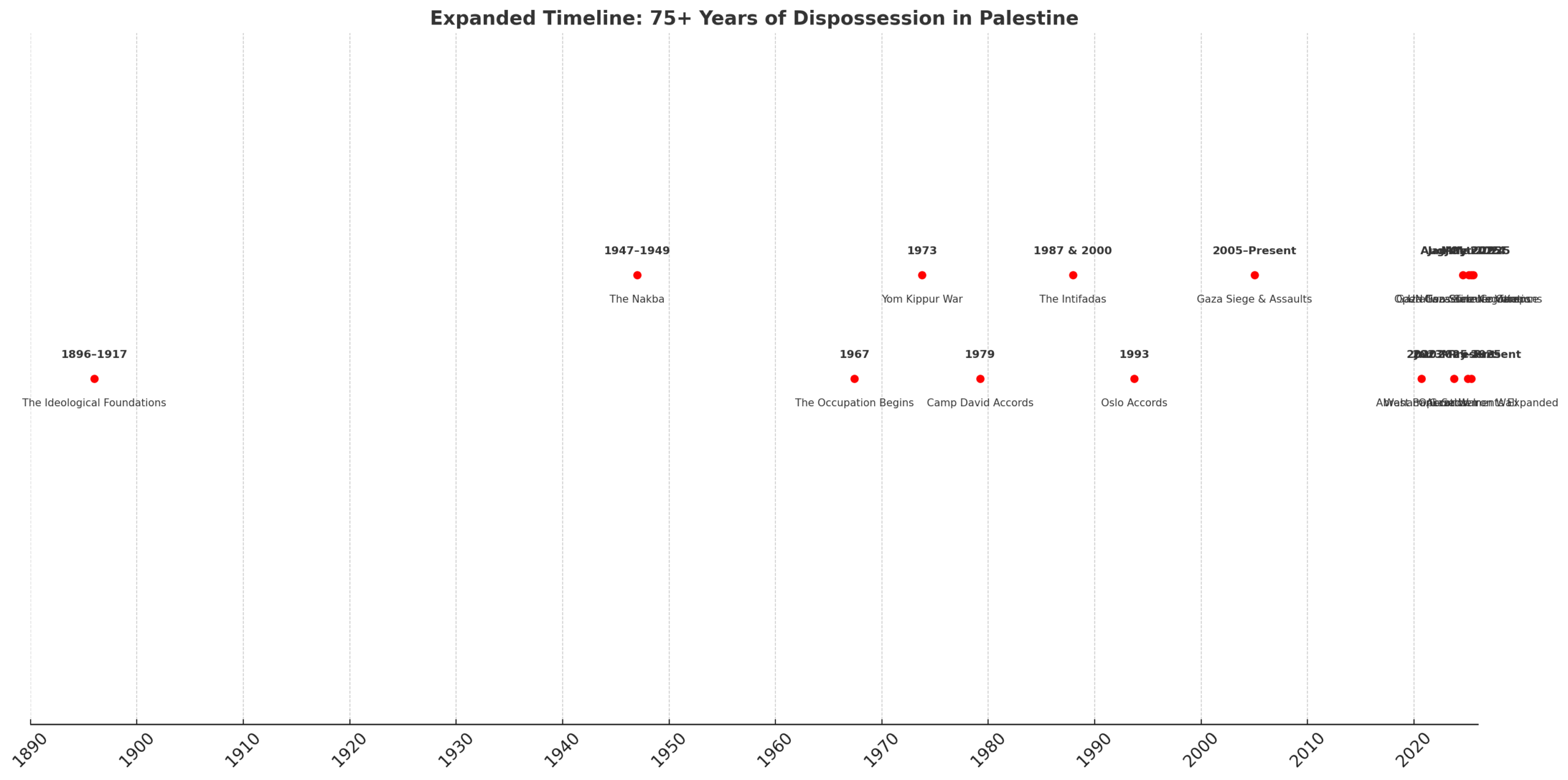
Visual Timeline Outline
| Period / Date | Title | Description |
|---|---|---|
| 1896–1917 | The Ideological Foundations | Herzl’s “The Jewish State” & the Balfour Declaration |
| 1947–1949 | The Nakba | UN Partition, Plan Dalet, 750,000+ displaced |
| 1967 | The Occupation Begins | Six-Day War: West Bank, Gaza, East Jerusalem, Golan occupied |
| 1973 | Yom Kippur War | Regional war reshaping peace diplomacy |
| 1979 | Camp David Accords | First Arab–Israel peace treaty (Egypt–Israel) |
| 1993 | Oslo Accords | Israel–PLO mutual recognition & interim Palestinian governance |
| 2000s | The Intifadas (Add Oslo context) | Uprisings amid stalled peace process |
| 2020 | Abraham Accords | Israel normalized ties with the UAE, Bahrain, and others |
| 2005–2023 | The Siege & Repeated Gaza Assaults | Blockade and recurrent Israeli military campaigns |
| Aug–Oct 2024 | Operation Summer Camps | Large-scale West Bank raids |
| Jan 2025–Present | Operation Iron Wall | Mass displacement in Jenin and the surrounding camps |
| Jan–Mar 2025 | Gaza Ceasefire Negotiations | Hostage deals and a temporary truce |
| Oct 2023–Present | Gaza War | Deadliest conflict; widespread destruction |
| May 2025 | Gaza Seizure Vote | Israeli Cabinet votes to reoccupy Gaza |
| May 2025 | Settlement Expansion | Legalization of 22 new West Bank settlements |
| July 2025 | UN Two-State Conference | Diplomatic push toward a sovereign Palestine |